
Child Safety Nets for Apartment Balconies — Complete Parent's Guide for AP and Telangana
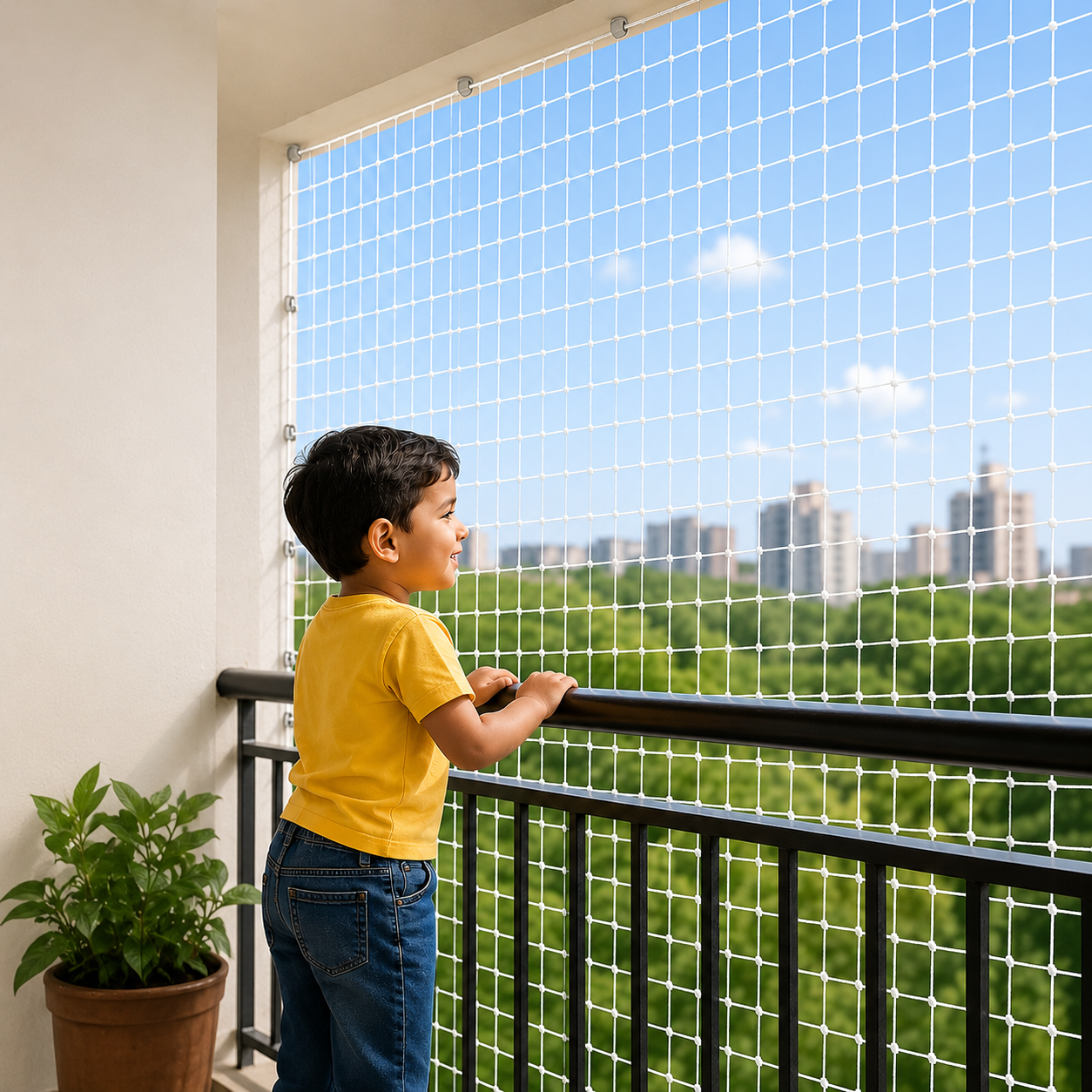
Child safety nets for apartment balconies — the one installation that cannot wait until it feels urgent
In This Guide
- Quick Answer
- Balcony Risk by Child's Age — When the Window Opens
- Is Your Current Railing Safe? — 4 Checks to Do Right Now
- Safety Net vs Invisible Grill — Which for Child Safety?
- Material — What UV-HDPE Means and Why It Matters for Children
- What a Child-Safe Installation Looks Like — 5 Checks
- When to Install — The Answer That Should Not Need Saying
- Beyond the Net — Other Balcony Safety Steps for Families
- Frequently Asked Questions
Every parent with a child and an apartment balcony in AP or Telangana has had the moment — the brief distraction, the sudden silence, the instinctive look toward the balcony. It passes in a second. The child is fine. But that second is the reason this guide exists. A safety net installation takes 2–4 hours. The balcony risk it eliminates is permanent, from the moment your child first becomes mobile until they are old enough to understand height. This guide covers everything a parent needs to make the right decision, quickly.
Quick Answer
Install child safety nets before your child becomes independently mobile — ideally before 6 months. UV-stabilised HDPE mesh, wall-anchored from floor to ceiling slab, covering the full balcony opening with no gaps at any edge. If you are already in the flat and your child is mobile, install immediately. Call or WhatsApp 94944 80732 — we visit the same day across all AP and Telangana cities. There is no version of this decision where waiting is the right choice.
Balcony Risk by Child's Age — When the Window Opens
The balcony safety window for children opens earlier than most parents expect and stays open longer than most realise. Here is the risk profile by developmental stage.
The highest-risk period is not when parents are watching. It is the 3–5 minute window that happens in every household, every day — the doorbell, the phone call, the sibling needing attention, the cooking moment. A crawling 9-month-old can travel 5 metres in 90 seconds. A safety net removes the balcony from the consequence calculation during those moments entirely. You do not need to watch the balcony any more than you need to watch the wall.
Is Your Current Railing Safe? — 4 Checks to Do Right Now
Before booking any installation, do these four checks on your balcony railing. They take 5 minutes and tell you exactly what level of risk your current railing presents to your child.
✅ Railing Height — Minimum 1 Metre
Stand a 1-metre ruler or tape measure at the balcony floor. The railing top should be at or above 1 metre. Most modern AP and Telangana apartments meet this standard — but older buildings and some budget constructions do not.
❌ Gap Width — Must Be Under 100mm
Measure the gap between railing balusters. If the gap is 100mm or wider, a child's head can pass through — entrapment risk. Many standard apartment railings have gaps of 130–180mm. A safety net closes all gaps regardless of railing design.
❌ Climbing Aids Near Railing
Check for any surface near the railing that a toddler could use as a step — flower pots, chairs, AC unit cases, stored boxes. Even a 20cm step gives a toddler enough height to reach over a 1-metre railing. Remove all climbing aids.
❌ Horizontal Bars in Railing Design
Railings with horizontal bars are a ladder for climbing children. Any horizontal element at child height — including decorative ledges — provides a foothold. A safety net eliminates the climbing surface concern entirely.
The safe standard for railing gaps is 100mm — the threshold below which a young child's head cannot pass. Place four adult fingers together — that is approximately 80mm. If four fingers fit through your railing gap with room to spare, the gap is at or above 100mm. If you can fit four fingers through your railing, your child's head can potentially follow. A safety net is the correct solution — not furniture rearrangement or partial blocking.
Safety Net vs Invisible Grill — Which Is Better for Child Safety?
Both safety nets and invisible grills provide certified child safety when correctly installed. The decision for a family with young children comes down to four practical factors.
| Factor | Safety Nets | Invisible Grills |
|---|---|---|
| Child fall prevention | ✅ Full mesh barrier — no gap for any body part | ✅ 75mm cable spacing — no child can pass through |
| Small object prevention | ✅ Fine mesh catches small balls, toys | ⚠️ 75mm gaps — small objects can pass through |
| Pigeon control | ✅ Full mesh — no bird can enter | ❌ 75mm gaps allow small birds |
| View impact | Slight — mesh visible at close range | Zero — cables virtually invisible |
| Cost | Lower | 3–5× higher |
| Best for | All floors, pigeon problem present, budget priority | Floors 7+, premium view, no pigeon problem |
| Child safety rating | ✅ Certified — same safety standard | ✅ Certified — same safety standard |
If your child is under 3 and you have a pigeon problem — install a safety net. It solves both problems simultaneously. If your child is any age and you are on floors 7+ with a premium view and no pigeon problem — invisible grills are the correct child safety solution and preserve your view completely. If unsure, our free site visit gives you a direct recommendation for your specific floor, city and family situation.
Material — What UV-HDPE Means and Why It Matters for Your Child
The material distinction for child safety nets is simple but critical. There are two types of HDPE net on the market in AP and Telangana — and they look identical at installation.
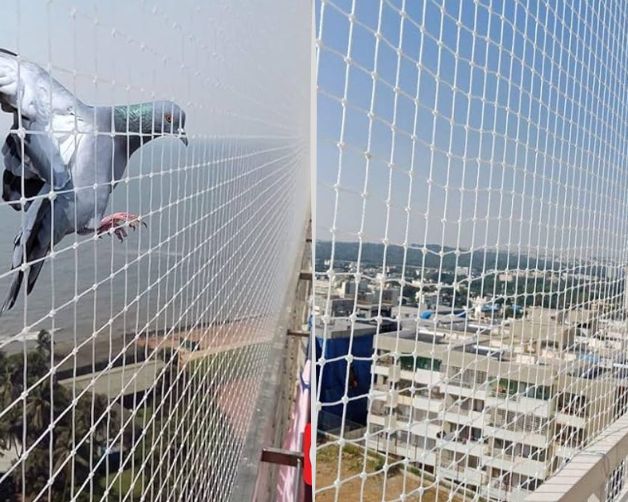
- UV-stabilised HDPE — contains a UV-stabiliser additive that prevents the mesh from degrading under direct sun. Holds full structural strength for 5–7 years in AP and Telangana conditions. Your child's safety net is as strong in year 5 as it was in year 1.
- Standard HDPE — no UV treatment. Becomes brittle and loses mesh strength after 2–3 AP summers of direct sun exposure. A net that looks intact visually may have lost significant structural strength — invisible until the mesh fails under load.
A safety net that loses structural strength is not just a replacement cost — it is a child safety failure. A mesh that looks intact but is UV-degraded will fail under the dynamic load of a child falling against it rather than the static weight it was designed for. Always confirm "UV-stabilised HDPE" specifically and get this in writing on the quotation before any installation begins.
What a Child-Safe Installation Looks Like — 5 Non-Negotiable Checks
A safety net that has gaps is not a child safety net. It is a partial barrier. These five checks confirm whether the installation is genuinely child-safe before you pay and before you allow your child back on the balcony.
Free Same-Day Site Visit — Across All AP & Telangana Cities
We visit the same day you call. We check your railing gaps, measure every balcony and recommend the correct child safety installation for your child's age and your building. UV-HDPE confirmed in writing. Wall-anchored. Tension-tested before we leave.
When to Install — The Answer That Should Not Need Saying
The correct answer is: before your child becomes mobile. Specifically, before crawling begins at 6–9 months. Ideally before the baby arrives in the flat at all — pre-move-in installation in the empty flat is the cleanest, fastest and safest approach.
If you are reading this and your child is already mobile, the correct answer changes to: today. Not this weekend, not after you have compared a few more quotes. The comparison can happen after the site visit — and the site visit is free and same-day.
If you are reading this because you had a near-miss — a child reaching the railing, a toddler climbing toward the balcony edge — the urgency is immediate. Call 94944 80732 right now. We prioritise near-miss situations across all AP and Telangana cities.
For families moving into a new apartment — in Hyderabad, Vijayawada, Amaravati, Warangal, Karimnagar or Khammam — book the safety net installation before your move-in date. An empty flat gives complete access to every edge and corner, installation is faster and cleaner, and your family arrives to a home that is safe from day one. Call or WhatsApp us on the day you receive your keys. Read our full pre-move-in guide: New Apartment? Install Safety Nets Before You Move In →
Beyond the Net — Other Balcony Safety Steps for Families with Children
A correctly installed safety net eliminates the fall risk. These additional steps address the remaining balcony safety factors that a net alone cannot.
- Balcony door latch at adult height. A standard balcony door handle at adult height is still reachable by a climbing 3-year-old using a chair. A secondary latch or lock at the very top of the door frame — above arm reach for a child — prevents unsupervised access to the balcony regardless of the net.
- Remove all climbing aids from the balcony. Chairs, tables, plant pot holders, storage items — anything a child can use as a step near the railing. After net installation, these items are less critical for fall prevention — but the habit of a clear balcony perimeter is worth maintaining.
- Check the balcony door track for gaps. Sliding balcony doors with worn tracks can sometimes be lifted and removed by children. Confirm the door is properly seated and cannot be lifted off the track.
- Inform all household members and visitors. Grandparents, domestic help, older siblings — everyone who cares for your child in the flat should know the balcony safety rule: net installed, balcony accessible under supervision, door remains latched when children are unsupervised.
- Annual net inspection. Once per year, pull the net firmly at multiple anchor points to confirm tension is maintained. Check edge gaps — particularly after heavy monsoon, which can work on anchor sealant over multiple seasons. If tension has reduced noticeably, call for a professional inspection.
Frequently Asked Questions
Your Child's Safety Cannot Wait for a Convenient Day.
Free same-day site visit · UV-HDPE confirmed in writing · Wall-anchored · Tension-tested · All AP & Telangana cities · Mon–Sun 8 AM–9 PM