
Ceiling Cloth Hanger for Balcony — Types, Installation and What to Ask Before Buying
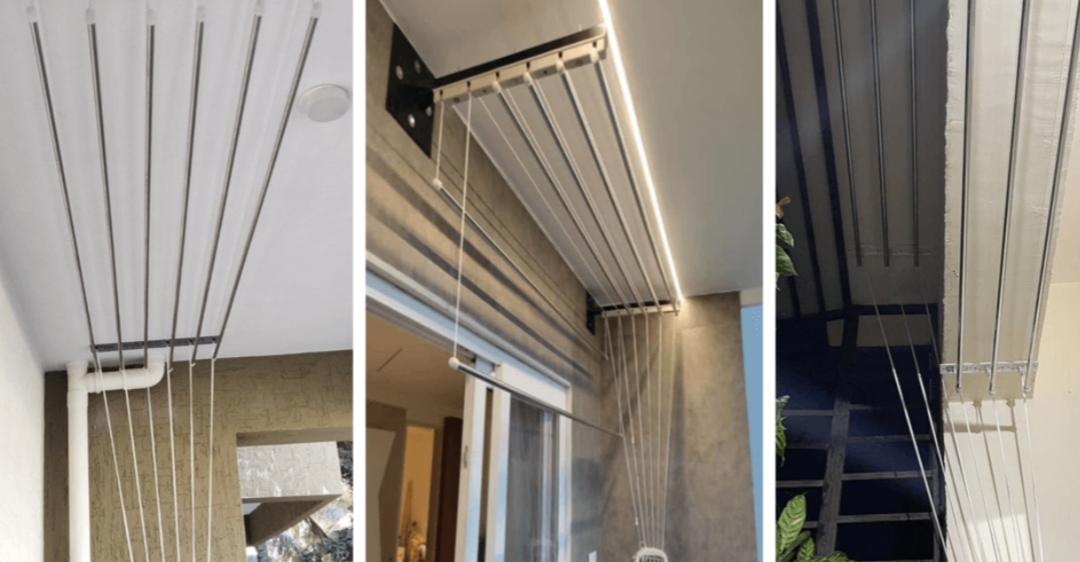
Ceiling cloth hangers — the most space-efficient drying solution for apartment balconies in AP and Telangana
In This Guide
- Quick Answer
- Fixed vs Pulley — Which Type Is Right for You
- How to Size Your Ceiling Hanger Correctly
- Ceiling Type — What Your Balcony Ceiling Needs to Support
- Why Ceiling Hangers Are Essential During AP and Telangana Monsoon
- What a Correct Installation Looks Like
- 4 Questions to Ask Before Booking
- Frequently Asked Questions
Apartment utility balconies in Hyderabad, Vijayawada, Guntur and across AP and Telangana face the same space problem — a small area that needs to dry a family's daily wash, fit a washing machine connection and still leave room to move. The floor-standing drying rack that worked in a house does not work in a 30 sq ft utility balcony. A ceiling cloth hanger permanently solves this problem by using the one dimension that floor racks cannot — vertical space. This guide tells you everything you need to know before booking one.
Quick Answer
For most AP and Telangana apartment utility balconies — choose a pulley ceiling cloth hanger with stainless steel rods, concrete ceiling anchors and a braided rope mechanism. Size it to leave 1 foot of clearance on each side. The pulley system lets you lower the rods to hang clothes comfortably and raise them to maximise airflow. Correct ceiling anchoring is the most important installation variable — SS expansion anchors drilled into the RCC ceiling, not plastic wall plugs. Our free site visit measures your balcony and recommends the exact configuration.
Fixed vs Pulley — Which Type Is Right for Your Balcony
Two main types of ceiling cloth hangers are installed across AP and Telangana apartments. They look similar but function very differently.
🔵 Pulley Ceiling Hanger — Recommended
- Rope-and-pulley mechanism raises and lowers the SS rods
- Lower to hang clothes at comfortable height, raise to dry near ceiling
- Maximises airflow — raised position near ceiling gets best cross-ventilation
- Practical for daily use — no bending or stretching required
- Ideal for senior citizens and families with back issues
- Standard for most AP and Telangana apartment installations
- Rope requires occasional check and replacement — every 3–5 years
🟡 Fixed Ceiling Hanger
- SS rods mounted at a fixed height permanently
- No mechanism — simpler, fewer moving parts
- Requires sufficient ceiling height — clothes must be reachable from the floor
- Better for utility rooms with 8–9 foot ceilings where fixed height is comfortable
- Less practical for standard apartment balcony ceiling heights of 9–10 feet
- Zero maintenance after installation
- Lower cost than pulley system
Most new AP and Telangana apartment utility balconies have ceiling heights of 9 to 10.5 feet. At this height, a fixed hanger puts rods at 7–8 feet — reachable but not comfortable for extended daily use. A pulley hanger allows rods to be lowered to 5–6 feet for hanging and raised to 7–8 feet for drying — far more practical for daily family use. Unless your balcony has a ceiling height below 8.5 feet (where a fixed hanger at 7 feet is accessible), the pulley system is the standard recommendation.
How to Size Your Ceiling Hanger Correctly
Sizing matters more than most buyers realise. A hanger that is too wide for the balcony leaves no walking room. A hanger that is too short underutilises the available drying space.
The Standard Sizing Rule
Hanger length = Balcony width minus 2 feet (1 foot clearance each side). This ensures the hanger fits without clothes touching the walls and leaves comfortable movement space.
Number of Rods
Standard ceiling hangers have 3 to 5 SS rods. For a family of 4 with daily washing, 4 rods on a 5-foot hanger provides adequate daily drying capacity. For larger families or homes with combined utility and drying use, 5 rods are recommended. Our site visit measures your specific balcony and confirms the rod count that matches your daily wash volume.
Balcony dimensions in AP and Telangana apartments vary widely even within the same builder's project — the same floor plan can have a 5-foot utility balcony in one block and a 7-foot one in another. Always measure the actual balcony before ordering or booking. Our free site visit includes measurement and confirms the correct size and rod count for your specific balcony — same day across all AP and Telangana cities.
Ceiling Type — What Your Balcony Ceiling Needs to Support the Installation
The ceiling type determines the anchor method — and anchor quality determines whether the hanger holds safely under the weight of a full load of wet clothes.
| Ceiling Type | Installation Method | Suitability |
|---|---|---|
| RCC (reinforced concrete) | SS expansion anchors drilled into concrete — correct method. Provides structural load-bearing connection. | ✅ Ideal — most AP and Telangana apartment balcony ceilings are RCC |
| Concrete slab with plaster | SS anchors drilled through plaster into concrete — correct. Must confirm anchor reaches concrete, not just plaster. | ✅ Good — confirm anchor depth reaches concrete |
| False ceiling / PVC ceiling | Cannot anchor into false ceiling material. Anchors must be drilled through to the structural ceiling above. | ⚠️ Possible — requires drilling through false ceiling to structural slab |
| Wooden ceiling | Wood screws into structural timber — load rating depends on timber quality and condition. | ⚠️ Case by case — confirm with installer on site visit |
Some budget installers use plastic wall plugs rather than SS expansion anchors for ceiling mounting. Plastic plugs pull out under sustained load — especially during monsoon when wet clothes add significant weight. Always confirm the installer is using stainless steel expansion anchors drilled into the structural concrete, not plastic plugs. Ask to see the anchor type before installation begins.
Why Ceiling Hangers Are Essential During AP and Telangana Monsoon
AP and Telangana receive 4 months of sustained monsoon rainfall — June through September — during which outdoor balcony drying is frequently interrupted. This is the primary reason ceiling cloth hangers are installed in virtually every new apartment across Hyderabad, Vijayawada, Karimnagar and all major AP and Telangana cities.
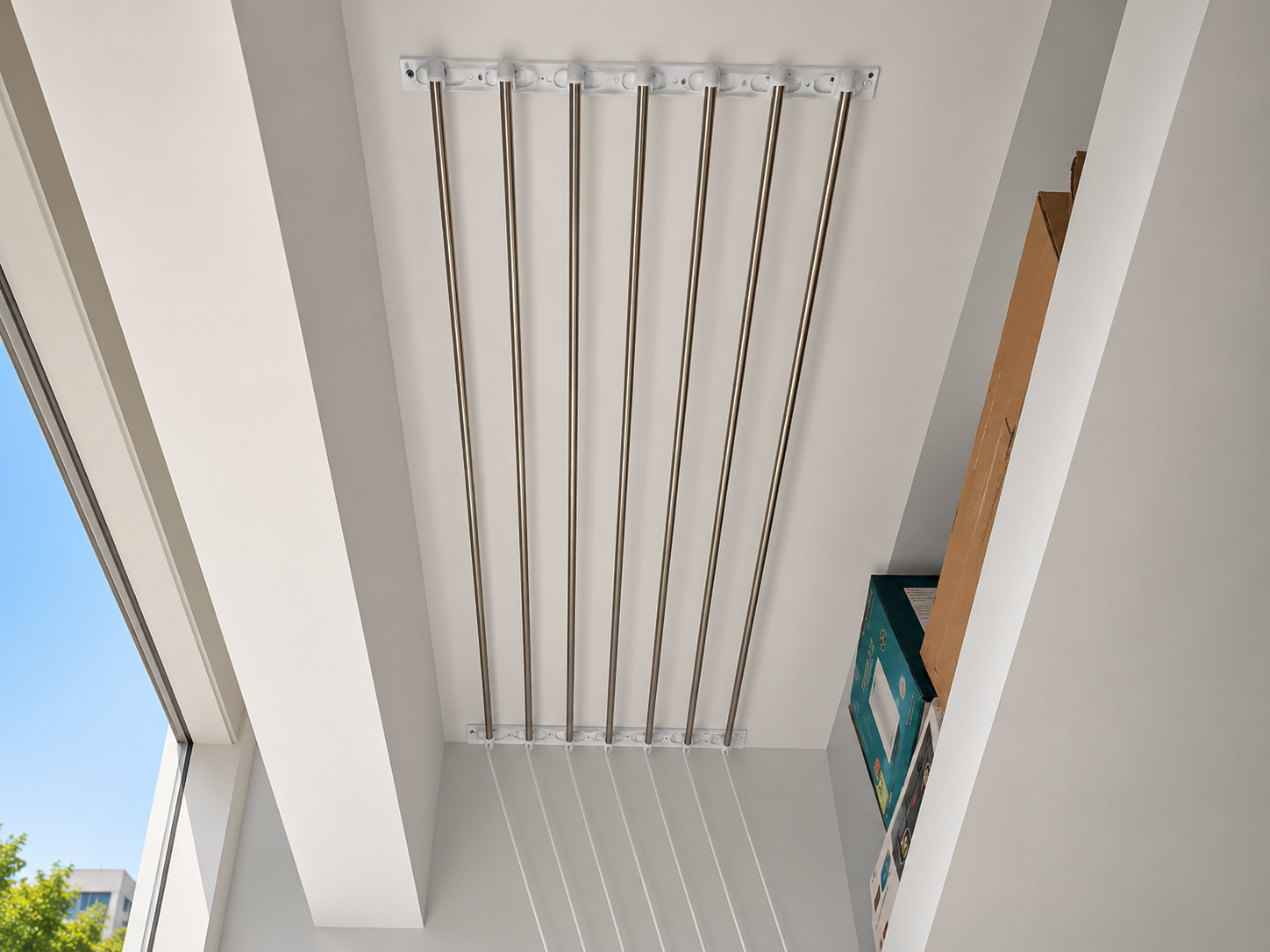
Why the ceiling position works during monsoon:
- Protected from direct rain. The balcony ceiling overhead keeps clothes dry while providing adequate ventilation through the open balcony face. Even during heavy monsoon, a covered utility balcony allows drying under the raised ceiling hanger.
- Maximises airflow. The raised position near the ceiling is where cross-ventilation is strongest in a covered balcony — warmer, less humid air near the ceiling draws moisture out of clothes faster than a floor-level rack.
- Frees floor space during monsoon. A floor drying rack in a small utility balcony during 4 months of monsoon creates constant obstruction. A ceiling hanger folds up and away when not in use.
- No risk of clothes getting damp on wet floor. A raised hanger keeps clothes away from the inevitable condensation and water that accumulates on balcony floors during monsoon.
The best time to install a ceiling cloth hanger is before the monsoon begins — ideally in March to May. Families who install in June or July face the wet season without the solution. Pre-move-in installation in a new apartment includes the ceiling cloth hanger alongside safety nets — all done in the empty flat before the family arrives.
Get a Ceiling Cloth Hanger Installed This Week
Free same-day site visit — we measure your balcony, recommend the right size and rod count, and install with proper SS ceiling anchors. All AP and Telangana cities.
What a Correct Ceiling Hanger Installation Looks Like
Installation quality is easy to verify before the installer leaves. Here is what to check:
4 Questions to Ask Before Booking a Ceiling Cloth Hanger Installation
1. What anchor type are you using — SS expansion anchors or plastic plugs?
The only acceptable answer for a concrete ceiling: SS expansion anchors. Plastic plugs are a cost-cutting measure that fails under wet clothes load. If the installer cannot name the anchor type, ask to see the hardware they intend to use.
2. What is the load rating of the system you are installing?
A correctly specified SS rod ceiling hanger should be rated for at least 15 kg. Confirm the specific load rating for the system being installed — not a generic claim.
3. Are the rods stainless steel — and what grade?
For outdoor balcony exposure in AP and Telangana's humidity, stainless steel rods are the only durable option. Chrome-plated MS rods rust within 1–2 monsoons. Ask specifically for SS rods. Grade 202 or 304 is acceptable for covered balcony use — Grade 316 if the balcony is directly rain-exposed.
4. Is the quotation all-inclusive — anchors, brackets, rods, rope and installation?
Confirm the written quotation includes all hardware and labour. "Anchors extra" or "rope replacement not included" on installation day are avoidable surprises with a clear pre-work quotation.
Frequently Asked Questions
Ceiling Hanger + Safety Nets — One Free Visit. One Installation Day.
Free same-day site visit · SS rod pulley hanger · Correct ceiling anchoring · All AP & Telangana cities · Mon–Sun 8 AM–9 PM